Data Science Full Course — Beginner To Advanced (Python, ML, Deep Learning) Episodes
The complete TechnovativeAI Data Science Course — 75 episodes, 8 modules, one continuous path from total beginner to production-ready data scientist.
This course is built on one principle: concepts first, then code. Every idea is explained before you ever see the syntax for it, so you always know why before you type. No tutorial hell, no copy-paste shortcuts.
The route:
① Foundations & Mindset — how data scientists actually think
② Computational Thinking — algorithms and decomposition
③ Math & Statistics — the parts that actually matter, with NumPy
④ Data Wrangling — real, messy data with pandas
⑤ ML Foundations — models and validation with scikit-learn
⑥ Deep Learning — neural networks with PyTorch
⑦ Specialized Domains — NLP, vision, and LLMs with Hugging Face
⑧ Production Practice — pipelines, deployment, and your capstone
From Episode 1, you'll frame a real problem from your own work or life — and it travels with you through the entire course, ending as a deployed, portfolio-ready capstone project.
🎬 Start with the 4-minute trailer, then Episode 1.
This course is built on one principle: concepts first, then code. Every idea is explained before you ever see the syntax for it, so you always know why before you type. No tutorial hell, no copy-paste shortcuts.
The route:
① Foundations & Mindset — how data scientists actually think
② Computational Thinking — algorithms and decomposition
③ Math & Statistics — the parts that actually matter, with NumPy
④ Data Wrangling — real, messy data with pandas
⑤ ML Foundations — models and validation with scikit-learn
⑥ Deep Learning — neural networks with PyTorch
⑦ Specialized Domains — NLP, vision, and LLMs with Hugging Face
⑧ Production Practice — pipelines, deployment, and your capstone
From Episode 1, you'll frame a real problem from your own work or life — and it travels with you through the entire course, ending as a deployed, portfolio-ready capstone project.
🎬 Start with the 4-minute trailer, then Episode 1.

Aug. 3, 2026
Welcome to pandas: Labeled Data Finally! | Data Science Ascent M4:E1 | Learn pandas for Beginners
You've spent three modules keeping your data together manually. Today, that changes. Welcome to Module 4, Episode 1 of Data Science Ascent. If you've ever wondered why data scientists love pandas, this is the episode you've been waiting for. Rather than treating pandas as another library to memorize, you'll discover that it is simply the natural evolution of everything you've already learned. A DataFrame isn't magic. It's a dictionary of labeled NumPy arrays, giving your data names, structure...
Aug. 2, 2026
The Full Statistical Workup | Module 3 Capstone | Data Science Ascent M3:E11
Everything you've learned in Module 3 comes together in one complete statistical investigation. Welcome to the Module 3 Capstone of Data Science Ascent. This isn't another collection of isolated examples. It's a complete, professional statistical workup on a realistic business dataset. You'll answer four executive questions using the tools you've built throughout Module 3, then translate your findings into a one-page executive brief that decision-makers can actually use. What You'll Learn 1️⃣...

Aug. 1, 2026
Matrix Operations Explained: The Engine Behind Every AI Model | Data Science Ascent M3:E10
🤖 Every modern AI model spends most of its time doing one thing... Matrix multiplication. Not reasoning. Not "thinking." Just multiplying matrices at incredible speed. Welcome to Module 3, Episode 10 of Data Science Ascent. In this episode, you'll discover why matrix operations are the computational engine behind machine learning, neural networks, and large language models. You'll learn how a dataset becomes a matrix, why X @ w scores every record simultaneously, how matrix multiplication ...
July 31, 2026
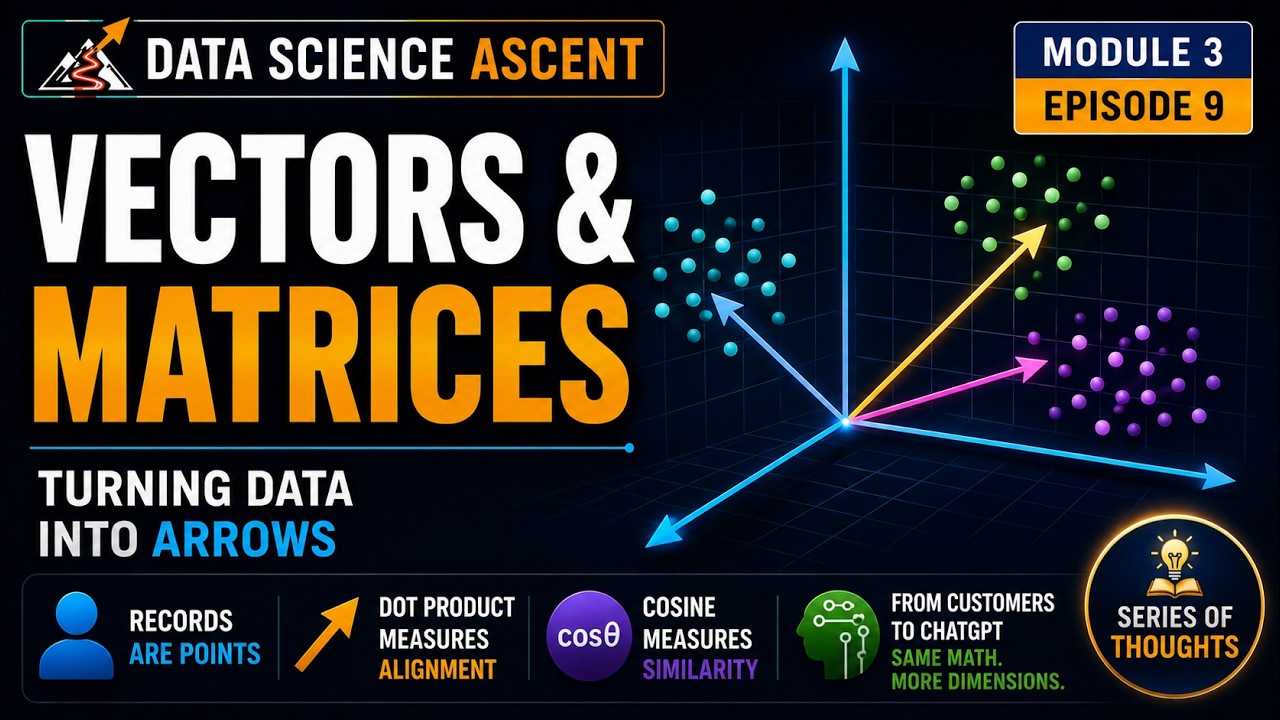
Vectors & Matrices: Turning Data Into Arrows | Data Science Ascent M3:E9
📈 What if every customer, every product, and every sentence could be represented as an arrow? That simple idea powers modern machine learning. Welcome to Module 3, Episode 9 of Data Science Ascent. In this episode, you'll make one of the biggest conceptual leaps in the course. Instead of viewing a dataset as rows and columns, you'll learn to see it as geometry. Every record becomes a vector. Every dataset becomes a cloud of points. Questions about data become questions about distance, directi...
July 30, 2026
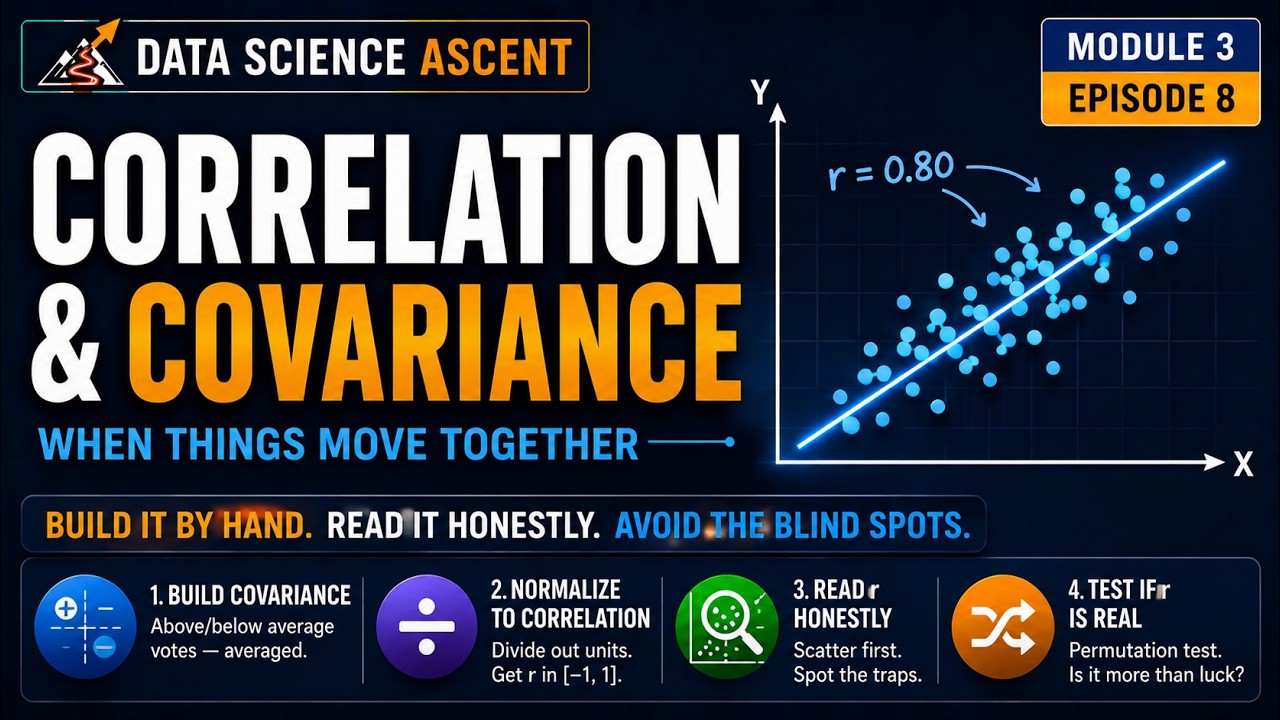
Correlation & Covariance Explained: What r Really Means | Data Science Ascent M3:E8
📈 "These variables are highly correlated." You've probably heard that phrase dozens of times. But what does r = 0.8 actually measure? And when does correlation completely fail? Welcome to Module 3, Episode 8 of Data Science Ascent. In this episode, you'll build covariance from scratch, transform it into correlation, learn how to interpret r honestly, and discover the famous blind spot that has fooled analysts for decades. You'll also see why every correlation should begin with a scatter plo...

July 29, 2026
Is It Real...or Just Wobble? Hypothesis Testing Explained | Data Science Ascent M3:E7
You found a pattern. But is it meaningful, or could random chance have produced it? Welcome to Module 3, Episode 7 of Data Science Ascent. In this episode, we revisit the customer churn finding from the Module 1 capstone. Segment B churned at 43%, compared with roughly 27% for Segments A and C. That is a 16-point gap, but Segment B contains only 61 customers. Could that difference simply be sampling wobble? You will answer that question by building a hypothesis test from scratch using NumPy....
July 28, 2026
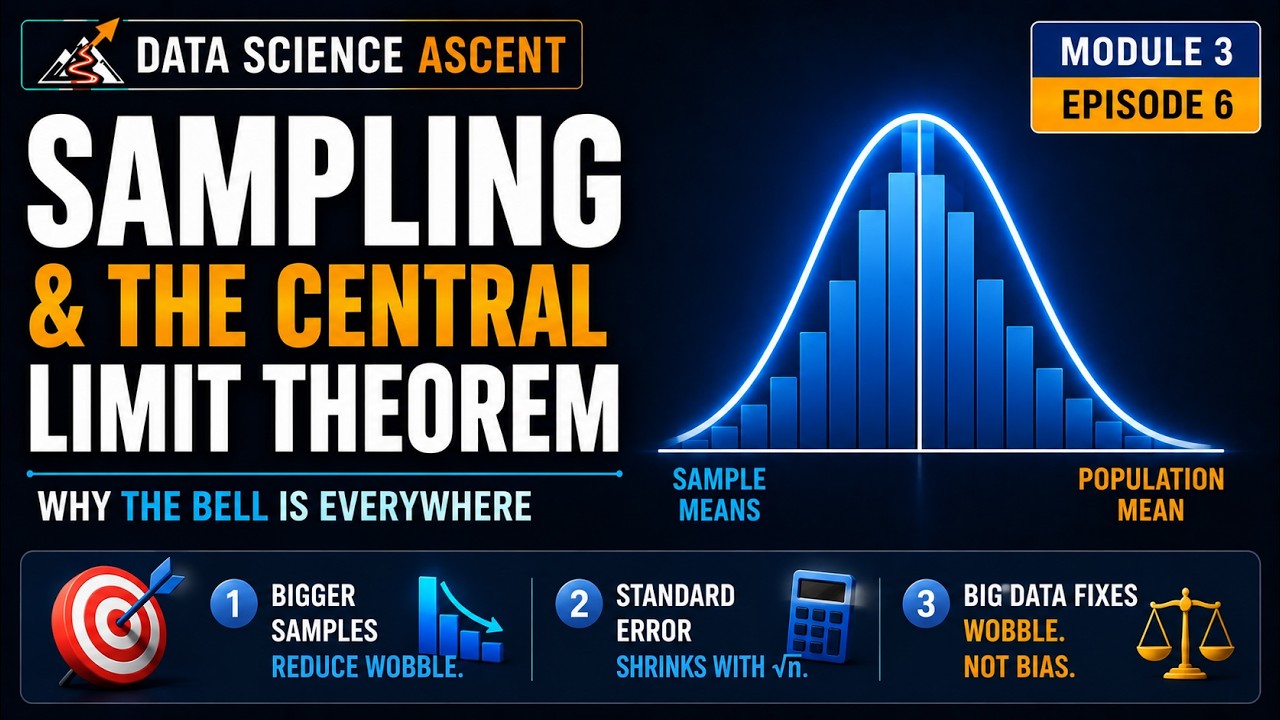
Sampling & the Central Limit Theorem: Why the Bell Curve Is Everywhere | Data Science Ascent M3:E6
🥄 How do you know if a pot of soup needs salt? You don't drink the whole pot. You taste one spoonful... ...if you stirred first. That simple kitchen analogy explains one of the most important ideas in all of statistics. Welcome to Module 3, Episode 6 of Data Science Ascent. In this episode, you'll discover why every dataset you've ever worked with is really just a sample, why averages become remarkably predictable, and why the famous Central Limit Theorem (CLT) is less about memorizing for...

July 27, 2026
Probability Explained: Think in Uncertainty Like a Data Scientist | Data Science Ascent M3:E5
🎲 What if a medical test is 99% accurate...and you're still probably NOT sick? It sounds impossible. But it's true. And understanding why will completely change the way you think about statistics, machine learning, and uncertainty. Welcome to Module 3, Episode 5 of Data Science Ascent. This episode introduces one of the most important ideas in all of data science: Probability isn't guessing. It's a disciplined way of reasoning under uncertainty. 🚀 What You'll Learn 🎯 Probability Is Just ...

July 26, 2026
Distributions: The Shapes of Data Explained | Data Science Ascent M3:E4
⚡ A Preview of the Log Transform What happens when business data has a huge whale tail? You'll get your first look at one of the most common preprocessing techniques in data science: The log transform. You'll see how applying np.log() compresses extreme values, making heavily skewed data appear much more balanced and preparing it for many machine learning algorithms. This is introduced as a preview that will be explored more deeply later in the course. 🔍 Shape Before Statistics By the end ...

July 25, 2026
Center & Spread: Three Numbers That Summarize Anything | Data Science Ascent M3:E3
📊 What if the "average" you've been reporting is telling the wrong story? A company advertises: Average salary: $87,000 Sounds impressive. Then you discover almost everyone earns around $52,000 while the CEO makes $2 million. Nobody lied. But the average alone hid the truth. Welcome to Module 3, Episode 3 of Data Science Ascent. In this episode you'll learn one of the most important lessons in statistics: A single number is almost never enough to summarize data honestly. 🚀 What You'll ...

July 24, 2026
Meet NumPy: Arrays & the End of Loops | Data Science Ascent M3:E2
🚀 For 17 episodes, you've written everything yourself. Every loop. Every accumulator. Every filter. Every running total. That wasn't busywork. It was preparation. Welcome to Module 3, Episode 2 of Data Science Ascent, where you finally write your first library import and discover why NumPy sits at the heart of modern data science. As the lesson explains, you didn't skip straight to NumPy because understanding the underlying mechanics makes the library far more intuitive. This is the mome...

July 23, 2026
Why Math? The Reasoning Engine Behind Data Science | Data Science Ascent M3:E1
🧮 Let's clear up one of the biggest myths in data science. You've probably heard one of these: ❌ "You need advanced mathematics to become a data scientist." Or... ❌ "You don't need any math at all." Neither is true. Welcome to Module 3, Episode 1 of Data Science Ascent. This episode reveals the honest middle ground. You don't need years of theoretical mathematics or endless proofs. But you do need a small, powerful toolkit that helps you reason about data, uncertainty, and machine learn...
July 22, 2026
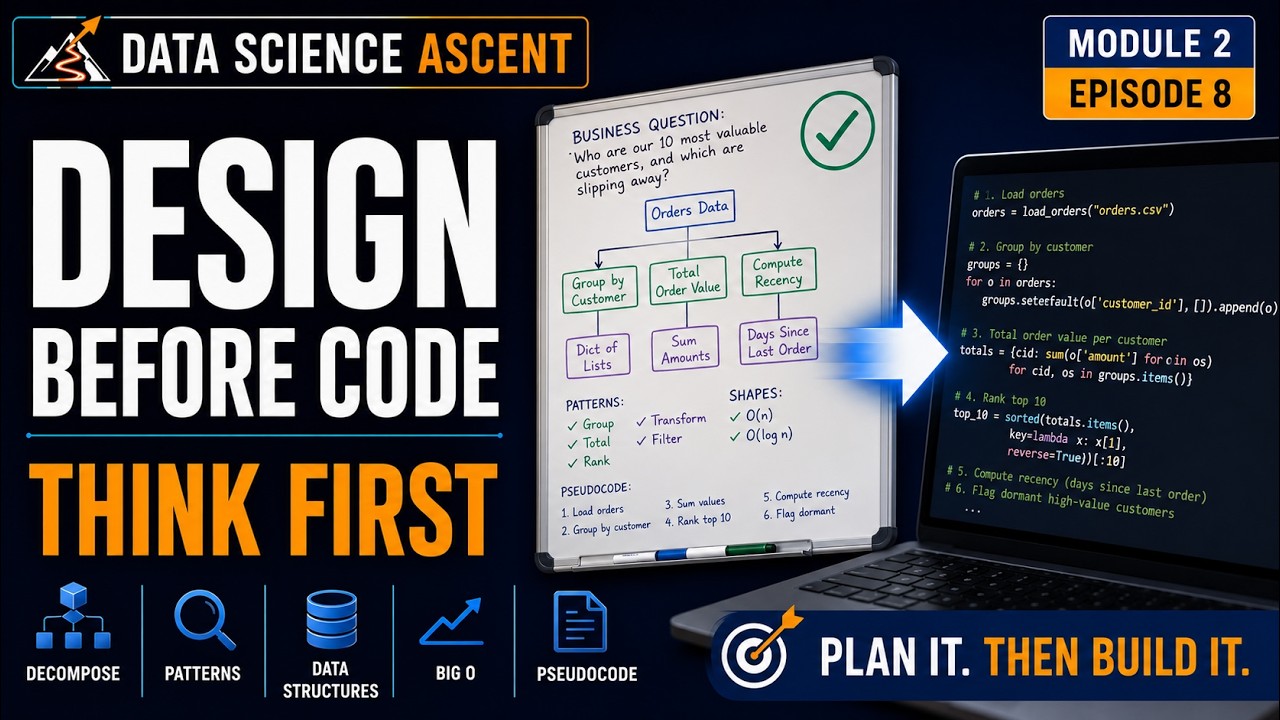
Design Before Code: Think Like a Senior Data Scientist | Mod2 Capstone | Data Science Ascent M2:E8
🧠 The biggest leap in programming isn't learning another language. It's realizing that code isn't the product. Design is. Welcome to the Module 2 Capstone of Data Science Ascent. Over the past seven episodes you've learned to: ✅ Break problems into manageable pieces. ✅ Recognize reusable computational patterns. ✅ Choose the right data structures. ✅ Predict algorithm performance. Now it's time to bring every skill together in one professional workflow. Today's challenge is deceptively s...

July 21, 2026
Big O Explained: Know It's Slow Before You Run It | Data Science Ascent M2:E7
🚀 What if you could predict that your code would take 11 hours...before you ever pressed Run? That's exactly what Big O gives you. It isn't just interview trivia. It isn't advanced computer science. It's one simple question: "When the data gets 10× bigger, what happens to the time?" Welcome to Module 2, Episode 7 of Data Science Ascent. In this episode, you'll learn one of the most valuable concepts in software engineering, data science, and machine learning: algorithmic efficiency. You'...
July 20, 2026
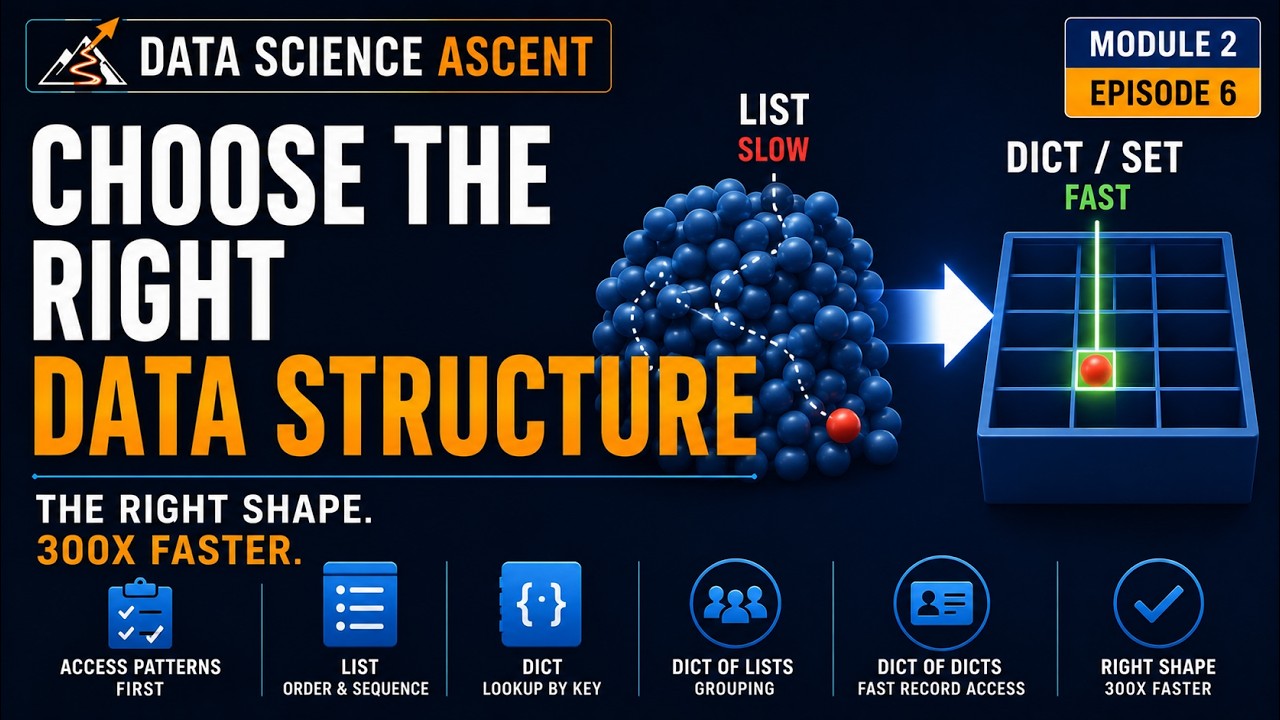
Choosing the Right Data Structure | Lists vs Dicts vs Sets Explained | Data Science Ascent M2:E6
🚀 What if your code could run 300 times faster...without changing your algorithm? Same data. Same computer. Same question. The only difference? The container holding your data. Welcome to Module 2, Episode 6 of Data Science Ascent, where you'll learn one of the biggest performance lessons in computer science: The shape of your data determines the speed of your code. Most beginners choose lists because they're familiar. Professional developers choose data structures based on access patte...

July 19, 2026
Search & Sort Explained: Why Binary Search Changes Everything | Data Science Ascent M2:E5
🔍 How do Google, databases, and search engines find what you're looking for so quickly? The answer isn't magic. It's algorithms. Welcome to Module 2, Episode 5 of Data Science Ascent. In this episode, you'll build two of the most important algorithms in computer science: ✔ Linear Search ✔ Binary Search Then you'll discover why sorting makes binary search possible, build your own sorting algorithm, and learn the professional way data scientists rank and organize real-world data. The lesson...

July 18, 2026
Algorithms & Pseudocode: Think Before You Code | Data Science Ascent M2:E4
💡 The biggest difference between beginner programmers and experienced engineers isn't typing speed. It's that professionals design first and code second. Welcome to Module 2, Episode 4 of Data Science Ascent. In previous episodes, you learned how to: ✅ Break large problems into manageable pieces. ✅ Recognize reusable computational patterns. ✅ Think through abstraction instead of memorizing syntax. Now it's time to transform those ideas into something a computer can execute: Algorithms. ...

July 17, 2026
Why Experienced Data Scientists Solve Problems So Fast, M2:E3
🧠 Senior data scientists don't memorize thousands of solutions. They recognize patterns. Give them a brand-new dataset from an unfamiliar industry, and within seconds they'll say: "This is just a group-and-count problem." How? Because they've learned to ignore the nouns and recognize the verbs underneath. Welcome to Module 2, Episode 3 of Data Science Ascent. In this episode, you'll develop one of the most valuable skills in data science and software engineering: Pattern Recognition. Yo...

July 16, 2026
Break Any Problem Into Simple Steps | Decomposition Explained | Data Science Ascent M2:E2
🧩 The hardest part of data science isn't writing code. It's figuring out where to begin. Imagine your manager walks over and says: "Analyze our customer data and tell us how to reduce churn." You know Python. You've built functions. You understand loops. Yet somehow...you stare at a blank screen. The problem isn't your programming skills. The problem is that the question is too big to grab. Welcome to Module 2, Episode 2 of Data Science Ascent. In this lesson, you'll learn one of the ...
July 15, 2026
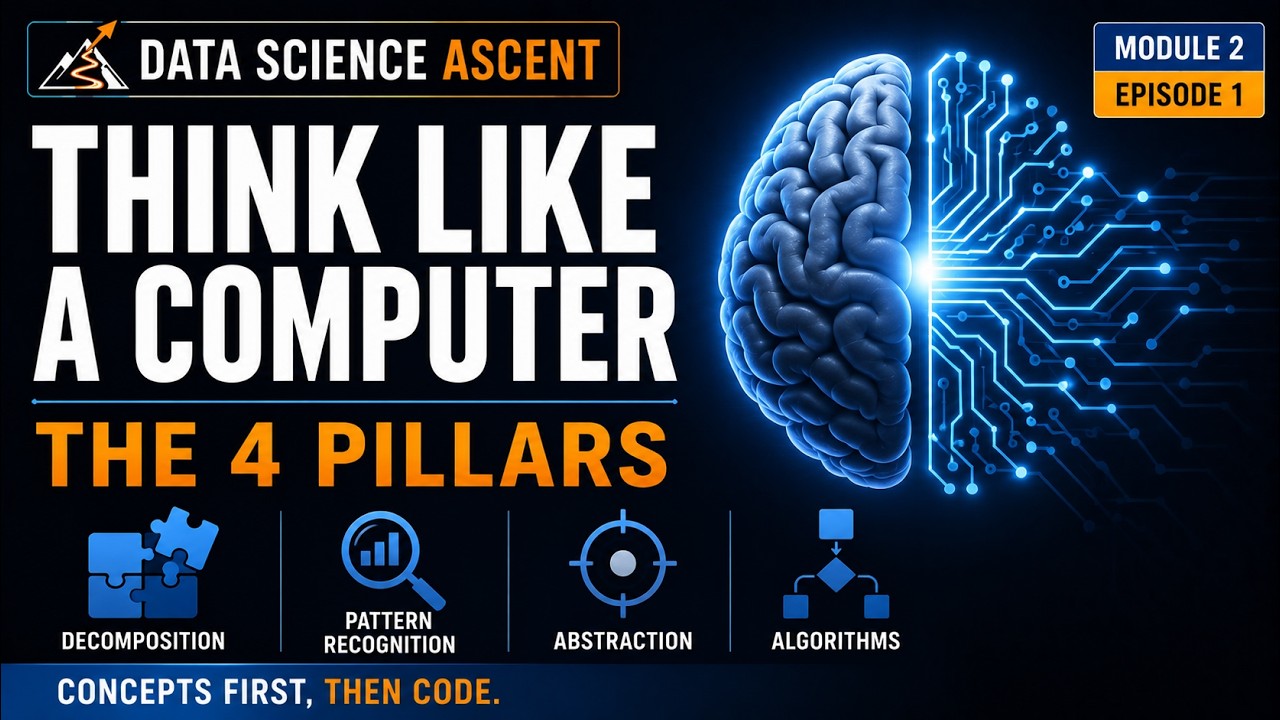
Thinking Like a Computer: The 4 Skills Every Data Scientist Needs | Data Science Ascent M2:E1
💻 Programming isn't about memorizing syntax. It's about learning a new way to think. Welcome to Module 2, Episode 1 of Data Science Ascent. You've completed Module 1. You learned Python. You analyzed real data. You built your first end-to-end data science project. Now comes the realization: You weren't just learning Python. You were learning computational thinking. In this episode, we uncover the four mental models that power every great programmer, data scientist, software engineer, an...

July 14, 2026
Your First Real Data Science Project in Pure Python | Module 1 Capstone | Data Science Ascent M1:E8
You've learned the fundamentals. Now it's time to put everything together. Welcome to the Module 1 Capstone of Data Science Ascent, where you'll complete your first end-to-end data science project using nothing but core Python. No pandas. No NumPy. No machine learning libraries. Just you, Python, and the analytical mindset you've been building throughout the first eight episodes. This capstone walks through the complete data science lifecycle, from asking the right business question to del...

July 13, 2026
Python Functions Explained: Write Clean, Reusable Code | Data Science Ascent Course | Episode 7
One of the biggest milestones in becoming a Python programmer is learning to think in functions instead of copy-and-paste code. In Episode 7 of the Data Science Ascent course, you'll learn how professional developers write reusable, maintainable Python code using functions, parameters, return values, and clean coding practices. This episode transforms repetitive scripts into reusable building blocks that you'll continue using throughout the rest of the course. You'll discover: ✅ Why copy-past...
July 12, 2026
Python Control Flow for Data Science | Decisions, Loops & Real Data Filtering (M1:E6)
🐍 Every data pipeline in the world is built from two simple ideas: decisions and repetition. Before pandas. Before machine learning. Before AI models. There are two questions every program needs to answer: 🔀 Should I do something? 🔁 How many times should I do it? Welcome to Data Science Ascent – Module 1, Episode 6: Python Fundamentals II – Control Flow. In this episode, we move beyond storing data and start making data move. You’ll learn how Python makes decisions, repeats actions, filter...

July 11, 2026
Set Up Your Data Science Environment the Right Way | Python, Anaconda, VS Code & Jupyter (M1:E4)
🐍 Before you write your first machine learning model, you need the right workspace. Many beginners do not quit data science because of algorithms or statistics. They get stuck because: "It worked in the tutorial… but it doesn't work on my computer." In Data Science Ascent – Module 1, Episode 4: Setting Up Your Environment, we remove that barrier. This is the first hands-on setup episode where we build the exact workspace you will use throughout the entire course: 🐍 Python 📦 Anaconda 💻 Visu...